
Preschool Bedtime Routine for Predictable Sleep
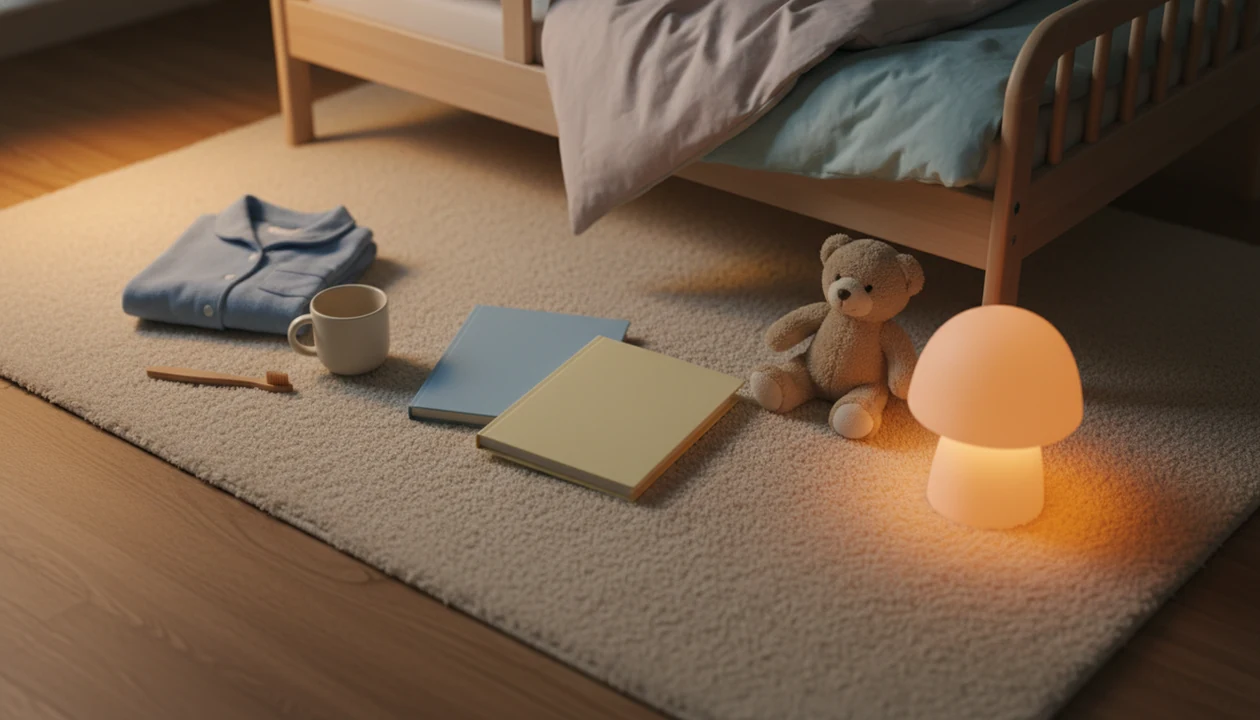
A preschool bedtime routine works best when it is short, predictable, and repeated in the same order every night: bathroom or bath, pajamas, teeth, story, cuddle, and lights out. Give your child small choices inside firm limits so bedtime feels calm without becoming a negotiation.
> Definition: A preschool bedtime routine is a consistent sequence of calming pre-sleep steps for 3- to 5-year-olds that signals sleep, supports independence, and ends with the child in bed sleepy but awake.
TL;DR
- Use 3–5 calming steps in the same order every night, usually lasting 15–30 minutes.
- Offer limited choices, such as two books or two pajama options, while keeping bedtime and lights-out fixed.
- Stop screens and active play 1–2 hours before bed, then use dim light, quiet voices, stories, lullabies, or cuddles.
What a Preschool Bedtime Routine Means at Night
A preschool bedtime routine is a repeatable set of quiet steps that helps a 3- to 5-year-old move from daytime activity to sleep. The usual order is bathroom or bath, pajamas, teeth, story, cuddle, and lights out.
That order matters because preschoolers want control, but they also need a predictable sequence. A child can choose dinosaur pajamas or striped pajamas without choosing whether bedtime happens. That balance lowers the nightly argument load.
The 7:15 p.m. scramble is real.
A routine also gives parents a shared script. If you use a story app, tools like Kids Bedtime TL can fit into the story step as a kids bedtime stories app, not as a replacement for the boundary that lights-out still comes next.
Five Preschool Sleep Facts Before You Start
- Children ages 3–5 generally need 10–13 hours of sleep in 24 hours, including naps, according to the American Academy of Sleep Medicine: https://jcsm.aasm.org/doi/10.5664/jcsm.5866.
- CDC sleep guidance also lists 10–13 hours per 24 hours for ages 3–5; if you keep a survey percentage here, cite the exact CDC or NSCH table that supports it: https://www.cdc.gov/sleep/aboutsleep/howmuch_sleep.html.
- A randomized bedtime-routine trial in 405 mother-child pairs found improvements in sleep onset, night wakings, and total sleep time within 3 nights, though the sample focused on younger children rather than preschoolers: https://pubmed.ncbi.nlm.nih.gov/19480226/.
- Effective routines commonly include a time-consistent bedtime, tooth brushing, book reading, screen avoidance, food and drink limits, and calming activities.
- The routine should end with the child in bed sleepy but awake, so falling asleep is not fully dependent on a parent staying there.
For preschool families, the most common medically supported way to improve bedtime consistency is a repeated routine combined with a stable sleep window.
How a Calm Preschool Bedtime Routine Works
A calm preschool bedtime routine works by turning repeated cues into a habit loop. The child’s brain begins to connect dim light, quiet voices, teeth brushing, a story, and a goodnight phrase with sleep coming soon.
Same order reduces uncertainty. It also cuts decision fatigue for tired parents. When the chart says teeth, story, cuddle, bed, you are not rebuilding the plan after every stall.
Dim light and low stimulation support the body’s wind-down process. Rough play, bright screens, and loud rooms can push bedtime later because they keep attention high. A familiar lullaby in a strange bed can still tell a child, “This is the sleep part now.”
Limited choices help because the child gets autonomy without controlling bedtime. Sleepy-but-awake endings support independent settling and easier resettling after normal night wakings.
How to Use a Bedtime Routine for Preschooler Sleep
Use a bedtime routine for preschooler sleep by setting the sleep window first, then repeating the same 3–5 steps every night. The goal is not a flawless evening. It is a predictable sequence your child can recognize even when everyone is tired.
Use the sleep window to protect the 10–13-hour daily sleep target, and treat screen shutoff as part of the routine rather than a last-minute punishment. The American Academy of Pediatrics recommends keeping screens out of bedrooms and avoiding media during bedtime routines: https://www.healthychildren.org/English/family-life/Media/Pages/Healthy-Digital-Media-Use-Habits-for-Babies-Toddlers-Preschoolers.aspx.
1. Set the sleep window
- Choose a bedtime and wake time based on your child’s total sleep needs, naps, daycare schedule, and morning mood.
2. Lower stimulation before bedtime
- Stop screens and rough play 1–2 hours before bed, then shift to dim light, quiet voices, and slower movement.
3. Follow the same steps
- Move through 3–5 steps in the same order, such as bathroom, pajamas, teeth, story, cuddle, and lights out.
4. Offer limited choices
- Give two controlled choices, such as book, pajamas, song, or stuffed animal, while keeping bedtime fixed.
5. Say goodnight once
- Use one brief goodnight phrase and leave while your child is sleepy but awake.
If timing is the hard part, a bedtime routine timeline can help you work backward from lights-out.
Preschool Bedtime Routine Chart for Independence
A preschool bedtime routine chart works best when it uses simple pictures, not text-heavy instructions. Keep it to 3–5 steps so your child can actually remember what comes next.
Picture steps: Use clear images for pajamas, teeth, story, cuddle, and bed. A hand-drawn toothbrush is enough.
Moveable marker: Let your child slide a magnet, flip a card, or place a sticker after each step. The small action gives ownership.
Chart as authority: Point to the chart instead of repeating “go brush your teeth” six times. Less talk often helps.
Caregiver match: Keep the same chart order across parents, grandparents, and babysitters when possible. For younger siblings, a toddler bedtime routine checklist may need fewer steps.
Preschool Bedtime Routine Steps by Age
Preschool bedtime routines should become more independent with age, but the core structure should stay stable. Age is not a reason to remove the routine too soon.
| Age | What usually helps | What to avoid |
|---|---|---|
| 3 years old | More physical help, fewer choices, short stories | Too many options or long explanations |
| 4 years old | Picture chart, simple jobs, one small choice per step | Changing the order each night |
| 5 years old | Preparing pajamas, choosing a story, understanding lights-out rules | Treating independence as no routine |
Bedtime routine for 3-year-olds
A 3-year-old often needs hands-on help with pajamas, teeth, and getting into bed. A bedtime routine for 3 year old should feel very concrete.
Bedtime routine for 4-year-olds
A 4-year-old can usually follow a picture chart and help check off steps.
Bedtime routine for 5-year-olds
A 5-year-old may choose the story and set out pajamas, while the adult still holds the lights-out rule.
Common Preschool Bedtime Routine Mistakes
The most common preschool bedtime routine mistake is making the routine too long. A routine with bath, lotion, three books, two songs, snack, water, bathroom again, and another cuddle can turn into a second evening.
Extra steps often appear after resistance begins. “Just one more story” sounds small, but it teaches a tired child that protesting can reopen the routine. Snacks and drinks can do the same if they are added only after stalling starts.
Screens are another common trap. TV may look quiet from the couch, but bright, fast-moving content is not the same as settling. Gentle kids bedtime stories, sleep meditation, lullabies, and nap routines for toddlers and young children provide a calm-down cue, not a guaranteed sleep fix.
For many preschoolers, a short routine is easier than an elaborate one because the boundary is clearer.
How to Tell a Routine for Preschool Sleep Is Working
Is my preschool bedtime routine working? Track the pattern, not one perfect night.
Write down bedtime start, lights-out time, time to fall asleep, night wakings, and morning mood. Do it for several days before deciding the plan failed. If limits are new, early protest is common. The hallway light may still be cracked open while you start the same story again.
Progress often looks ordinary. Fewer reminders. Shorter negotiations. A child who moves to the next chart step without a full reset. The pocket check for a missing stuffed rabbit may still happen, but it does not need to restart bedtime.
Connect calming stories, lullabies, or sleep meditation for kids to the same routine step each night. Apps such as Kids Bedtime TL, Moshi, Calm, and Headspace can support that step when the content is age-appropriate and predictable.
Limitations
A preschool bedtime routine can support sleep, but it cannot solve every bedtime problem. Some patterns need medical, developmental, or family-specific guidance.
- A routine cannot fully solve sleep apnea, major anxiety, pain, reflux, or developmental concerns.
- Progress may take several days to a few weeks of consistent follow-through.
- Baths can energize some children, especially if bath time becomes loud play.
- Snacks may help a hungry child, but food or drinks too close to bed can delay settling.
- Multiple caregivers, co-parenting differences, and shift work can make consistency harder.
- Night lights, white noise, sleep clocks, stories, and meditation apps can support bedtime, but they are not magic solutions.
- Families should seek medical or professional guidance for loud snoring, breathing pauses, severe distress, or persistent sleep disruption.
Clinicians typically recommend checking breathing concerns, pain, and severe anxiety rather than treating them as routine problems.
FAQ
What time should a preschooler go to bed?
A preschooler’s bedtime depends on wake time, naps, and the 10–13 hour total sleep target over 24 hours. Many families choose bedtime by working backward from the required morning wake time.
How long should a preschool bedtime routine take?
A preschool bedtime routine usually works well at 15–30 minutes. If it regularly stretches longer, there may be too many steps or too much negotiation.
Should preschoolers choose their own bedtime stories?
Preschoolers can choose between two bedtime stories while the adult keeps the number of stories fixed. This gives choice without handing over the bedtime limit.
Do preschoolers need bedtime routine charts?
Bedtime routine charts are optional, but they often help preschoolers understand the sequence and take small responsibility. They can also reduce repeated verbal reminders.
Is TV okay before bed for preschoolers?
TV is usually not ideal before bed because screens can keep children more alert and delay settling. Stopping screens 1–2 hours before bedtime is a safer routine choice.
Why does my preschooler stall at bedtime?
Preschool bedtime stalling often comes from autonomy, separation, overtiredness, or inconsistent limits. A predictable routine with limited choices can reduce repeated negotiations.
Should bedtime include a snack for preschoolers?
A small predictable snack can help if your child is genuinely hungry before bed. Food or drinks may delay sleep if they are large, sugary, or added after stalling begins.
When should preschool bedtime struggles improve?
Some families see improvement within a few nights of consistent routine use. Stable change can take several weeks, especially if limits have changed.