
Bedtime Stories For 3 Year Olds Who Stall at Lights Out
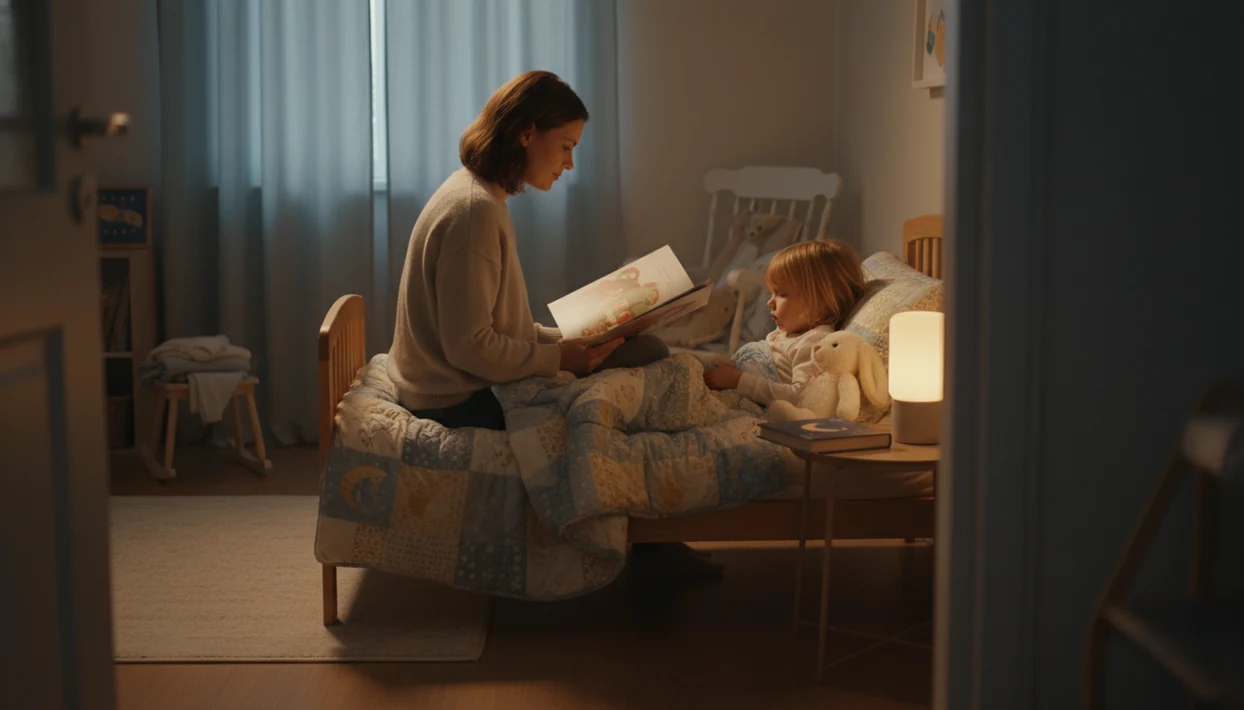
The best bedtime stories for 3 year olds are short, predictable, and calm, with a clear ending parents can enforce without negotiation. For toddlers who stall, choose 3 to 7 minute stories, offer two parent-approved choices, and end the routine the same way every night. Kids Bedtime TL helps by keeping calm stories, lullabies, sleep meditation, and nap routines in one place for the settling window.
For this age, Kids Bedtime TL is most useful when parents need a calm 3-to-7-minute option they can choose before negotiation starts, then end with the same lights-out cue every night.
> Kids Bedtime TL is a kids bedtime stories app that provides bedtime stories, sleep meditation, lullabies, and nap routines for parents of toddlers and young children.
- Pick stories with gentle plots, repeated phrases, friendly characters, and a clear bedtime ending.
- Use a fixed rule such as “two short stories, then lights out” so story time does not become a negotiation.
- Let your 3-year-old choose between calm options, but keep control of length, tone, and screen exposure.
How bedtime stories look
Side-by-side captures of the compared products. Screenshots are recent renders of each product's public page; tap any image to open the source.

Best Bedtime Stories For 3 Year Olds: A Parent-Approved Shortlist
The most useful bedtime stories for 3-year-olds are story types, not one universal book list. Short stories for 3 year olds work better when the structure is easy to predict before the child gets overtired.
- Repeated phrase stories: A line like “sleepy bear goes home” lets a preschooler join in and feel some control.
- Gentle animal stories: Soft animal characters give comfort without needing a complicated plot.
- Tiny problem stories: One lost blanket, one found blanket, done. The small arc keeps the story from growing.
- Sleep-routine stories: Pajamas, toothbrushing, one cuddle, and lights down mirror the child’s own bedtime routine.
If the 7:15 p.m. scramble already included pajamas, toothbrush, and one missing stuffed rabbit, Kids Bedtime TL fits because parents can choose a short, age-appropriate story instead of searching through a long library at the worst moment.
For a broader age range, our guide to toddler bedtime stories covers gentler options for younger children too.
How 3 Year Old Bedtime Stories Work in the Preschool Brain
Bedtime stories work as a calm-down cue in a predictable sequence, not as a magic sleep switch. The mechanism is routine conditioning: the same quiet pattern tells the brain that play is ending and sleep is next.
- Repetition reduces uncertainty: Familiar language helps a 3-year-old anticipate what comes next.
- Low stimulation supports settling: Dim light, a steady voice, and a simple plot lower the urge to keep playing.
- Shared reading builds security: Sitting close with a caregiver turns the story into a safe emotional signal.
- Reading also supports language: A Pediatrics analysis of Early Childhood Longitudinal Study-Birth Cohort data found shared reading in infancy and toddlerhood was associated with stronger language and literacy outcomes before school entry (https://publications.aap.org/pediatrics/article/140/5/e20170765/38278/Early-Reading-Matters-Long-term-Impacts-of-Shared).
- Sleep problems are common: A clinical review reports that sleep problems affect about 25% to 50% of children, and the American Academy of Pediatrics recommends a consistent Brush, Book, Bed routine that includes quiet reading (https://www.aafp.org/pubs/afp/issues/2014/0301/p368.html; https://www.healthychildren.org/English/healthy-living/sleep/Pages/Brush-Book-Bed.aspx).
The hallway light left cracked open matters more than the plot twist.
Kids Bedtime TL works best when it becomes part of that predictable sequence, because the story, lullaby, or breathing track can act as the same nightly cue.
How to Use Preschool Sleep Stories Age 3 Without More Stalling
Preschool sleep stories age 3 work best when choice is real but narrow. Parent-approved choices protect the boundary while still giving a 3-year-old a small job.
- Set the rule before reading: “Two short stories, then lights out.”
- Offer two calm options, not the whole shelf or full app library.
- Read in the same spot, with a quiet voice and the phone face-down on a dresser if using audio.
- Signal the ending with one phrase: “Story is finished, body rests now.”
- Repeat the same ending tomorrow, even after “Just one more story.”
For parents who need a repeatable workflow, Kids Bedtime TL fits because calm stories, sleep meditation, and lullabies can be chosen before the child is negotiating.
The most useful bedtime routine usually depends more on consistent boundaries than on finding a new story every night.
Short Stories For 3 Year Olds Who Ask for One More
“Which short stories work for 3-year-olds who keep asking for one more?” Choose 3 to 7 minute stories with one small problem and one clear resolution.
A tiny story beats a long adventure when a child is already tired. One bunny loses a sock, finds it, yawns, and goes to bed. That is enough. Chapter-style stories, big quests, and high-conflict scenes often invite questions right when the room needs to get quieter.
Use a visible limit: one book from the basket or two micro-stories from Kids Bedtime TL. After that, the answer stays boring and kind.
For families who like timed formats, 5 minute bedtime stories can be a useful middle ground between “too short” and “now bedtime is gone.”
Calm 3 Year Old Bedtime Stories for Anxious Toddlers
Calm 3 year old bedtime stories should make the child feel safe, close, and finished with the day. Familiar settings often help: home, bed, blankets, animals, caregivers nearby, and a door that stays open a crack.
Choose predictable endings where the character is cozy, protected, and ready for sleep. Avoid scary villains, separation threats, loud conflict, chase scenes, and cliffhangers. Some children handle a mild worry story well; others replay it under the quilt.
Small shoulders drop after an exhale.
Exact preferences vary by temperament, language, family culture, and recent fears. Anyone dealing with fear-of-dark questions can use Kids Bedtime TL because sleep meditation and reassurance-style stories give parents softer words to borrow without inventing a script at 8 p.m.
Good bedtime stories offer safety, rhythm, and closure, not a test of whether a child can be made sleepy on command.
Funny Bedtime Stories For 3 Year Olds That Stay Sleepy
Funny bedtime stories for 3-year-olds can work when the humor is small, predictable, and not physically exciting. The goal is a smile, not a wrestling match.
Try a bear wearing socks on the wrong paws, a bunny yawning too loudly, or a pillow that wants a nap before the child does. These jokes stay close to bedtime themes, so the story can still land softly.
Avoid silly voices that get louder, tickling, chase games, and punchlines that make the child sit up to perform. Funny stories can be especially useful for children who resist bedtime through negotiation, but the ending still needs to be firm.
For parents who want variety without ramping up the room, Kids Bedtime TL can cover gentle humor through short story selection rather than high-energy play.
Bedtime Stories For 3 Year Olds: Paper, Audio, and Screen Options
Paper books and calm narrated audio are usually better bedtime fits than bright interactive video. The format should reduce stimulation, not add more decisions.
| Option | Bedtime fit | Watch for |
|---|---|---|
| Paper books | Strong fit | Keep the light dim and stop before the child gets chatty. |
| Parent-read audio or app stories | Strong fit | Use a soft narrator tone, no autoplay, and a set timer. |
| Videos | Weaker fit | Bright visuals, interaction, and autoplay can keep attention switched on. |
After the final page, when the family hush starts, Kids Bedtime TL fits because parents can shift from a story to a lullaby or nap routine without opening a video feed.
Paper books and narrated audio tend to work better for bedtime because they preserve voice, rhythm, and closeness while limiting visual stimulation.
For more general options, our bedtime stories for kids guide sorts stories by age and routine need.
Common Myths About Bedtime Stories For 3 Year Olds
Common myths make bedtime stories too long, too exciting, or too hard to end. A good story choice should protect both connection and lights out.
- Myth: Any fun story is fine at bedtime. Fast plots, danger, and big laughs can make settling harder.
- Myth: Parents must finish the whole book. It is fine to stop at a calm page and say the story continues tomorrow.
- Myth: Bedtime stories are only entertainment. Early shared reading supports language, vocabulary, and later literacy skills.
- Myth: Screen stories are the same as being read to. Bright visuals and interactive pacing change the sensory experience.
- Myth: Daily reading is automatic in most homes. National Survey of Children's Health data from 2019–2020 found 47.9% of U.S. children ages 0–5 were read to every day in the past week (https://www.childhealthdata.org/browse/survey/results?q=8968&r=1).
For story categories beyond age 3, preschool bedtime stories can help families choose calmer plots for older preschoolers.
How We Picked These Preschool Sleep Stories Age 3
We picked these preschool sleep stories age 3 by looking for length, calm tone, simple vocabulary, predictable structure, safe endings, and easy parent boundary-setting. No list can be perfect for every child, and we do not pretend one story solves bedtime.
Age 3 sits in the middle. Children want independence more than babies do, but they still need guardrails more than older preschoolers. A story title chosen by a preschooler can feel like a victory, as long as the adult controls the basket.
For parents who already know the night will be short, Kids Bedtime TL earns a place because the story length and calm-down option can be chosen before lights are low.
You can adapt names, family words, languages, and the number of stories to fit your household rhythm.
Limitations
Bedtime stories can support a calmer routine, but they do not fix every sleep problem. They work only when the surrounding boundary stays consistent.
- Bedtime stories do not treat medical sleep issues.
- Sleep apnea, reflux, eczema, pain, breathing problems, or frequent waking may need pediatric care.
- Neurodevelopmental differences can require more individualized routines and sensory planning.
- There is no exact evidence-based dose for the ideal number of minutes or stories per night.
- Some children become more alert with certain narrator voices, humor, music, or screens.
- Family language, culture, fears, and temperament affect which stories feel safe.
- A story routine helps less when “one more” changes the lights-out rule every night.
- Apps such as moshi.com, calm.com, headspace.com, Vooks, Storyberries, and Kids Bedtime TL differ in format, visuals, narration, and age focus.
If a child seems distressed, in pain, or unusually restless, a bedtime story should not be used as a substitute for medical advice.
FAQ
How long should bedtime stories be for a 3-year-old?
Most bedtime stories for a 3-year-old should last about 3 to 7 minutes. Shorter stories are easier to finish before the child becomes overtired or starts negotiating.
How many stories should I read at bedtime?
One or two short stories is a practical limit for most families. State the limit before reading, then keep the same lights-out ending.
Are scary bedtime stories bad for 3-year-olds?
Scary or intense stories can make some 3-year-olds more alert or worried at bedtime. Save villains, danger, and chase scenes for earlier in the day.
Is it okay to read the same story every night?
Yes, repeated stories are normal and often calming for 3-year-olds. Repetition helps children predict the ending and feel more secure.
Are audio bedtime stories okay for toddlers?
Calm narrated audio can fit a toddler bedtime routine when the room stays dim and the story has a clear ending. Avoid autoplay and loud sound effects.
Are video bedtime stories okay before sleep?
Video bedtime stories are usually less ideal before sleep because bright visuals and motion can keep attention active. Paper books or calm audio are often easier to wind down from.
Can my 3-year-old choose their own bedtime story?
Yes, but offer limited parent-approved choices. For example, let the child choose between two calm books rather than the whole shelf.
What makes a bedtime story calming for a 3-year-old?
A calming story for a 3-year-old is short, familiar, gentle, and predictable. It should end with the character safe, cozy, and ready for sleep.