
Breathing Exercises for Kids at Bedtime
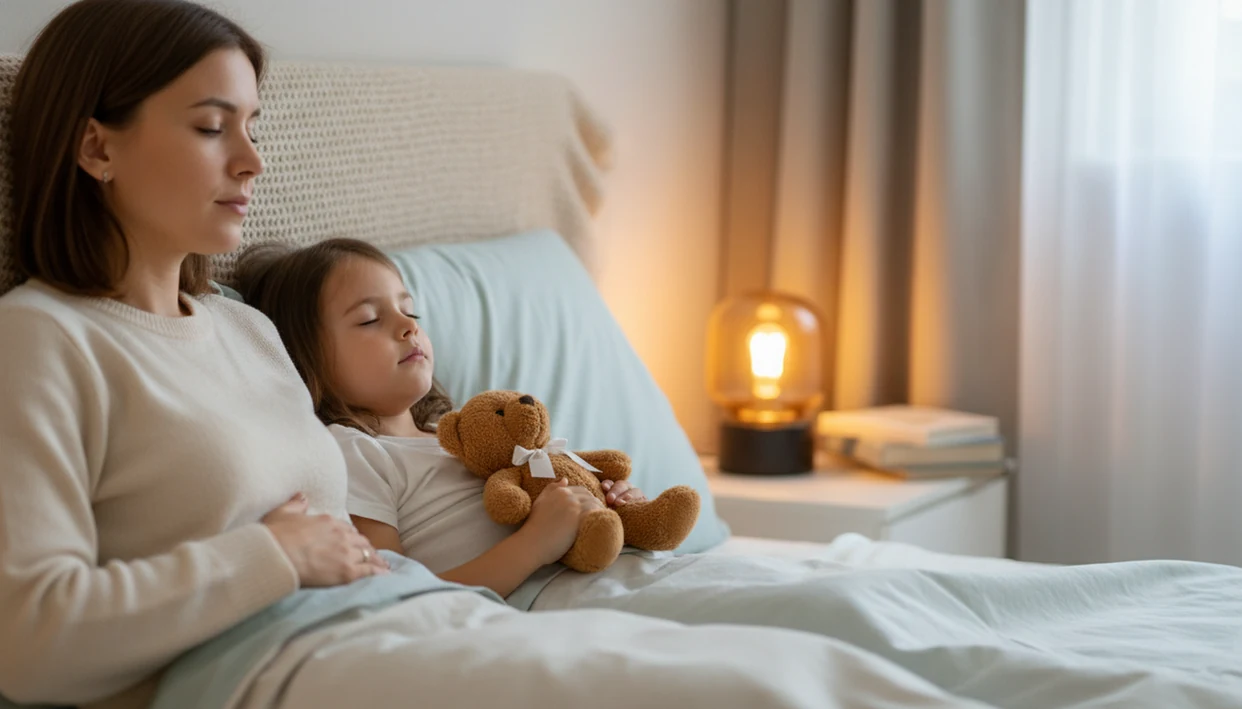
Breathing exercises for kids bedtime work best when they are short, playful, and repeated in the same calm order each night. Start with one easy belly-breathing game for 1–3 minutes, then pair it with a story, lullaby, or sleep meditation so your child learns the pattern without pressure.
> Definition: Kids bedtime breathing means simple, child-friendly breathing games that help children slow their bodies and settle into a predictable sleep routine.
This guide is educational and is not a substitute for medical advice. If your child has asthma, sleep apnea symptoms, chest pain, fainting, or acute breathing trouble, skip breathing exercises and contact a pediatrician or urgent care.
- Use slow belly breathing, not fast or energizing breath patterns, before sleep.
- Keep each exercise playful and brief: 1–3 minutes is enough for many toddlers and young children.
- Stop if the exercise becomes silly, frustrating, or turns into a bedtime power struggle.
At-a-glance kids bedtime breathing routine
Try one short breathing exercise after pajamas, teeth, and story time, then move straight into lights out. The goal is a gentle calm-down cue, not an instant sleep switch.
Use a soft voice and breathe with your child instead of correcting every inhale. If the stuffed rabbit is finally found at 7:15 p.m., keep the routine small: three belly breaths, one quiet phrase, done. Good kids bedtime stories, sleep meditation, lullabies, and nap routines for toddlers and young children deliver a predictable settling sequence, not a guaranteed sleep result.
Tools like Kids Bedtime TL can support that sequence with stories, sleep meditation, lullabies, and nap routines. Use the app as the surrounding routine, then let the breathing stay simple.
No performance check.
How slow belly breathing calms a child at bedtime
Slow belly breathing is diaphragmatic breathing: the child breathes low into the body so the tummy gently rises on the inhale and softens on the exhale.
That slower rhythm can help the nervous system read the room as safer. Longer, softer exhalations are often used in relaxation programs because they reduce the “ready to run” feeling that shows up as tossing, chatter, or one more trip down the hall. Pediatric sleep guidance commonly emphasizes a consistent, calming bedtime routine before adding techniques; the American Academy of Pediatrics’ Brush, Book, Bed program uses the same predictable-order principle source.
Research is related, not exact. A 2018 randomized trial of bedtime meditation and relaxation for children with sleep-onset problems found about a 16-minute reduction in time to fall asleep compared with controls source. A review of relaxation-based interventions for children and adolescents found anxiety benefits across studies, but that evidence is indirect for bedtime breathing games specifically source. For children, slow breathing usually works best when paired with the same predictable bedtime sequence, while stand-alone instructions can feel like another task.
Safety checks before calming breaths for children
Use calming breaths for children only when the body is already partly settled. They are usually a poor fit at the peak of crying, panic, coughing, or argument.
- Choose a calm moment, such as after a story, not the loudest part of a meltdown.
- Model the breath yourself, then invite your child to copy if they want.
- Keep lights low, voices quiet, and the phone face-down on the dresser.
- Avoid deep breathing during acute breathing difficulty, uncontrolled asthma, or when a clinician has advised against it.
- Stop if your child becomes more silly, tense, dizzy, upset, or awake.
The hallway light can stay cracked open. Safety beats technique every time, especially for children with breathing conditions, heart conditions, or strong anxiety around body sensations.
How to use sleep breathing exercises in a bedtime routine
Put sleep breathing exercises near the end of the routine, after connection and before lights out. That placement helps breathing become the final bridge from awake to resting.
- Start with bath or wash-up, pajamas, and teeth.
- Read one short story or play a quiet read-aloud option.
- Choose one breathing exercise and repeat it for several nights.
- Model the breaths slowly without asking for perfect form.
- Close with the same phrase, such as “Your body can rest now.”
- Turn the lights down and avoid adding a new game.
If your child likes guided audio, bedtime meditation for kids can sit in the same spot as the story or just before the breathing. Keep the order steady for at least a week before changing it.
Step 1: Teach belly breathing for kids bedtime
Belly breathing is the easiest foundation for kids bedtime breathing because children can feel it in their bodies. A hand, blanket fold, or tiny stuffed animal gives them something concrete to notice.
- Ask your child to lie down and place one hand or a small stuffed animal on the belly.
- Say “Breathe in through your nose and let your belly rise like a balloon.”
- Pause long enough for the belly or toy to lift a little.
- Say “Breathe out through your mouth and let the balloon get soft.”
- Repeat only 3 to 5 breaths.
If the plush fox tips over, do not fix it like a lesson. Wiggling and shallow breaths are normal. For younger children, the parent’s calm breathing matters more than the child’s exact technique.
Step 2: Try flower and candle calming breaths for children
Flower and candle breathing turns calming breaths for children into a pretend game. It works well for toddlers, preschoolers, and children who settle through imagination.
- Hold one hand up as the pretend flower.
- Invite your child to “smell the flower” with a small nose inhale.
- Raise one finger as the pretend candle.
- Whisper “Now blow out the candle slowly.”
- Repeat three times, keeping the exhale longer and softer than the inhale.
The exhale should not look like birthday-cake blowing. Make it gentle, almost like warming cold fingers. If your child turns it into roaring wind, smile once, then end the exercise and return to the bedtime phrase.
Step 3: Use finger-tracing kids bedtime breathing
Finger-tracing kids bedtime breathing gives children a tiny movement to organize their attention. It can help anxious, highly sensitive, or neurodivergent children when the pattern stays predictable.
- Hold one hand open.
- Trace up the outside of the thumb while inhaling.
- Trace down the other side while exhaling.
- Continue across all five fingers for five slow breaths.
- Keep the tracing small, quiet, and close to the body.
Some children focus better when their hands have a job. A thumb rubbing a satin blanket tag can become part of the same settling cue. For kids who need more body-based calming, a body scan for kids sleep may fit after breathing or on a different night.
Tiny movement counts.
Step 4: Add count-to-four sleep breathing exercises
Count-to-four sleep breathing exercises are better for school-age children who understand numbers. Counting gives the mind a quiet anchor, not a bedtime test.
Avoid box breathing or long breath holds as the default bedtime pattern for kids. A simple inhale-exhale count is easier to stop, adjust, or abandon if your child feels dizzy, worried, or too alert.
- Invite your child to inhale for 4 counts and exhale for 4 counts.
- Adjust to inhale for 3 and exhale for 4 if that feels easier.
- Skip breath-holding if your child dislikes it or feels worried.
- Repeat 4 to 6 rounds at most.
- End before your child starts negotiating the numbers.
Keep your voice slower than you think. A sibling listening from the top bunk may copy the count, and that is fine. If counting makes your child tense or competitive, go back to belly breathing or flower-candle breaths.
Common kids bedtime breathing mistakes
The most common kids bedtime breathing mistakes happen when a calming tool becomes another demand. Bedtime breathing should feel like a cue, not a compliance exercise.
- The command trap: “Do your breathing or no story” turns the exercise into pressure.
- The novelty loop: Switching exercises every night prevents one pattern from becoming familiar.
- The energizing breath: Fast, dramatic, or forceful breathing can wake children up.
- The instant-sleep expectation: Breathing may reduce restlessness, but it will not work every night.
- The silly spiral: If the game becomes loud or overstimulating, stop kindly and move on.
The “Just one more story” moment is where many routines stretch. A short sleep meditation for kids can help some families hold the boundary without adding another long read-aloud.
A 5-minute bedtime breathing script for children
Does a 5-minute bedtime breathing script for children need special wording? No. It needs a soft voice, a short sequence, and a clear ending.
Pair the script with a bedtime story, lullaby, or sleep meditation so it feels like one predictable sequence. Kids Bedtime TL is a kids bedtime stories app that provides bedtime stories, sleep meditation, lullabies, and nap routines for parents of toddlers and young children. For children who get more anxious at night, a gentle sleep meditation for anxious child can be a useful companion to simple breathing.
Parent script
“Your body worked hard today. I’m going to breathe slowly, and you can copy me if you want. Put one hand on your belly. Breathe in, belly rises. Breathe out, belly softens. Let’s do that three times.”
“Now smell the flower. Blow out the candle softly. Smell the flower. Blow out the candle. One more time, tiny and slow.”
“Your breathing is done for tonight. The story is over, the room is quiet, and your body can rest.”
Limitations
Breathing exercises are supportive, not a cure for chronic insomnia, sleep apnea, asthma symptoms, or medical sleep disorders. Use them as one part of a bedtime routine, not as proof that a child should be able to sleep on command.
- Ask a pediatrician about persistent snoring, gasping, breathing trouble, chronic insomnia, frequent nightmares, or severe sleep disruption.
- Evidence specific to bedtime breathing games is limited compared with broader relaxation and pediatric anxiety research.
- Some children become silly, frustrated, or more awake during imaginative exercises.
- Deep breathing may be inappropriate during acute respiratory illness, uncontrolled asthma, certain heart conditions, or clinician-restricted activity.
- Power struggles can cancel out the calming effect.
- Stop if your child reports dizziness, chest discomfort, panic, or fear during breathing.
If meditation seems to backfire, bedtime meditation side effects kids explains common reasons children may resist quiet body-focused practices.
FAQ
What breathing helps kids sleep?
Slow belly breathing is the best bedtime starting point because it is simple, body-based, and easy to model. Flower-candle breaths and finger tracing are also useful playful options.
How long should bedtime breathing take?
Bedtime breathing usually only needs 1–5 minutes. Consistency matters more than making the session longer.
Can toddlers do breathing exercises?
Toddlers can try very short pretend breaths, especially flower-candle breathing or stuffed-animal belly breathing. Keep it playful and stop after a few breaths.
Why does my child resist breathing at bedtime?
Children may resist because they feel pressured, overtired, silly, anxious, or confused by the exercise. Make it easier, model it yourself, or skip it for the night.
Are breath holds safe for kids?
Breath holds are not necessary for bedtime breathing and may bother younger or anxious children. Gentle inhale-exhale patterns are usually a safer starting point.
Can breathing stop bedtime anxiety?
Breathing may ease mild bedtime anxiety by giving the body a calming cue. It does not replace professional help for severe anxiety, panic, trauma symptoms, or worsening fears.
Should kids breathe through the nose?
Nose-in and mouth-out is a useful cue for many children. Comfort matters more than perfect technique, especially if a child is congested.
When should I call a doctor about my child’s sleep or breathing?
Call a pediatrician for persistent snoring, gasping, breathing trouble, chronic insomnia, worsening nighttime fear, or repeated night wakings that disrupt daily life. Seek urgent care for acute breathing difficulty.