
Can Kids Sleep With Headphones Safely?
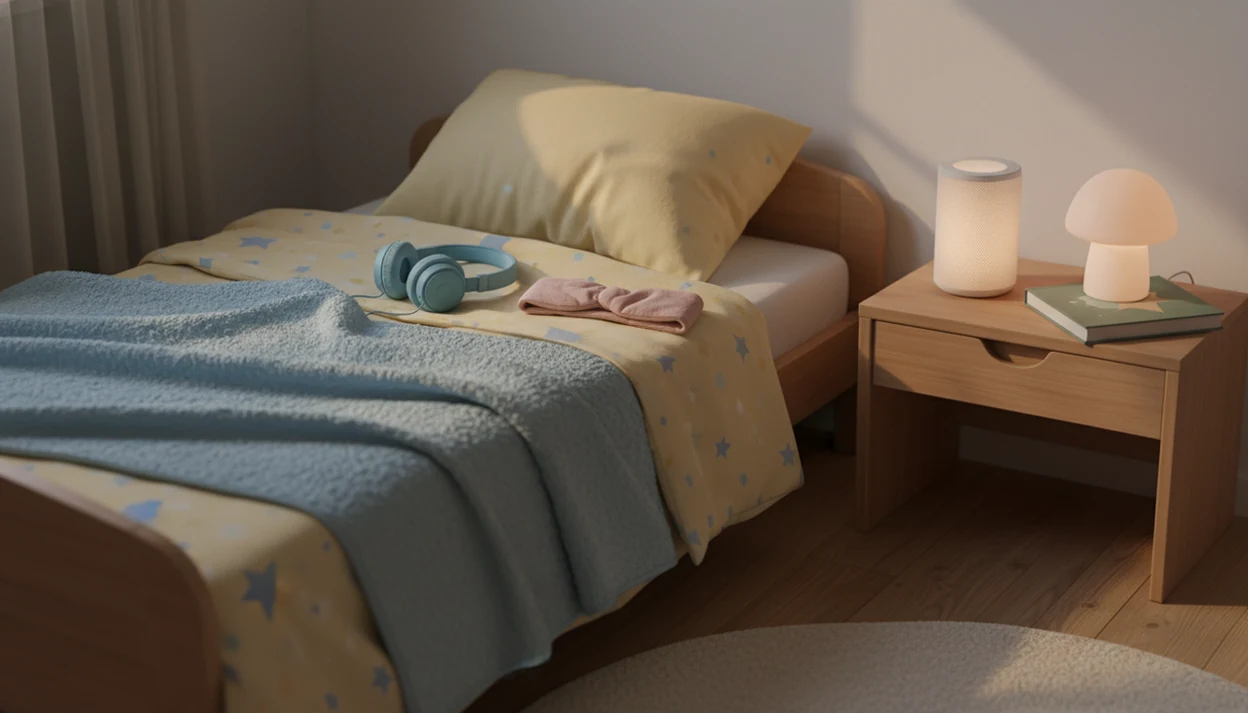
Usually, can kids sleep with headphones is a cautious “sometimes, but not all night and not for very young children.” The safer bedtime setup is low-volume audio on a timer, preferably through a nearby speaker or, for older kids, wireless volume-limited over-ear or soft headband headphones used with parent checks.
For this article, kids sleeping with headphones means a child falling asleep while wearing earbuds, over-ear headphones, or sleep headband headphones for bedtime stories, lullabies, meditation, white noise, or similar audio.
- The biggest safety issue is hearing exposure: low volume, short duration, and a timer matter more than the label on the product box.
- Toddlers and preschoolers should generally avoid sleeping with headphones, especially corded models or earbuds.
- A low-volume speaker near the bed is usually the safest bedtime audio option because nothing sits in or on the child’s ears.
Can Kids Sleep With Headphones at Bedtime?
Yes, some older kids can fall asleep with headphones, but it should not be the nightly default. The safety decision depends on age, volume, fit, cords, and how long the audio plays after the child is asleep.
Babies, toddlers, and many preschoolers face higher risks because their ears are smaller, they move unpredictably, and they may not report pressure or pain clearly. Corded headphones also do not belong in a young child’s sleep space.
A safer default is a low-volume speaker, a 20 to 30 minute timer, and a parent check before lights-out. Tools like Kids Bedtime TL can be used as bedtime audio through a room speaker or timed routine, rather than something a child wears all night.
The hallway light stays cracked open for the check.
Five Kids Headphones Sleep Safety Facts Parents Should Know
- Kids headphones sleep safety depends on age, volume, headphone type, fit, and duration. A wireless headband on a nine-year-old for 20 minutes is a different risk than earbuds on a toddler all night.
- Hearing risk rises when audio is too loud or plays for hours. The CDC says sounds around 70 dB are unlikely to cause hearing damage over a typical day, while repeated exposure at 85 dB or higher can increase risk over time: https://www.cdc.gov/hearing-loss/about/noise.html.
- Cords and small parts are physical hazards in bed. A cord can tangle during sleep, and detachable pieces can become a choking concern.
- Earbuds are a poor fit for many younger children. They sit closer to the eardrum, can press inside a small ear canal, and may trap warmth or moisture.
- Wireless volume-limited headbands or speakers are safer than standard headphones. For bedtime audio, the safest option is often audio the child can hear without wearing anything.
At 7:15 p.m., after pajamas, toothbrush, and one missing stuffed rabbit, simpler is safer.
How Bedtime Audio Headphones Affect Children’s Ears
Headphones deliver sound energy close to the ear canal, so the same story can expose a child’s ears more directly than a speaker across the room. The key hearing terms are decibels and exposure duration; in plain language, loudness and time both matter.
A soft-spoken story for 20 minutes is not the same as white noise or a playlist running until morning. Per the CDC, sounds at or below about 70 dB are considered safer for typical daily exposure, while repeated exposure at 85 dB or above can raise the risk of noise-induced hearing loss.
The National Institute on Deafness and Other Communication Disorders notes that personal listening devices at high volume can reach about 105 dB, a level that can damage hearing with enough exposure: https://www.nidcd.nih.gov/health/noise-induced-hearing-loss. Children may not wake up, complain, or notice when the level is too high. A phone face-down on a dresser helps keep the screen dark, but the volume still needs a parent’s ear check.
Age-Specific Guidance for Sleep Headphones Children Use
Sleep headphones children use should be judged by developmental stage, not only by product age labels. Younger children need more caution because they move more, communicate discomfort less reliably, and may not hear a parent or alarm.
| Age group | Bedtime headphone guidance | Safer choice |
|---|---|---|
| Babies | Do not use headphones in sleep spaces. Avoid cords, loose objects, and anything worn on the head. | No bedtime headphones |
| Toddlers | Generally avoid sleep headphones, especially earbuds and cords. | Low-volume speaker |
| Preschoolers | Avoid routine headphone sleep use. Supervise any short audio closely. | Speaker with timer |
| School-age kids | Consider only wireless, comfortable, volume-limited options with a timer. | Headband or speaker |
| Older children | Use volume caps, breaks, and no all-night playback. | Timed audio |
Babies and toddlers
For babies and toddlers, headphones are not a sleep-space item. If bedtime audio helps, keep it outside the crib or bed area.
Preschool and school-age kids
Preschool and school-age children still need parent checks. They should be able to hear a nearby adult, especially during illness, storms, travel, or nighttime emergencies.
Earbuds, Over-Ear Headphones, and Sleep Headbands for Kids
Different bedtime audio headphones carry different risks, and the lowest-risk option may not be headphones at all. Compare where the sound sits, what touches the child, and what could move during sleep.
| Option | Main concern | Bedtime safety note |
|---|---|---|
| Earbuds | Closest to the eardrum, harder to fit, may trap moisture | Not recommended for younger children, especially during sleep |
| Corded over-ear headphones | Easier to place, but cords are a major sleep hazard | Avoid in bed |
| Wireless over-ear headphones | No cord, but bulky and still potentially loud | Use only with volume checks and a timer |
| Soft sleep headband headphones | More comfortable for some side sleepers | Better for older kids, not a free pass |
| Speaker | Nothing worn in or on the ears | Usually the lowest physical risk |
A yawn hidden behind a plush fox can make any device look harmless. Still check fit, heat, and pressure before sleep.
Safer Bedtime Audio Headphones Rules for Parents
If headphones are used at bedtime, use rules that reduce both hearing and physical risk. Volume-limited labels can help, but they are not a substitute for parent testing in the actual bedroom.
- The nearby-voice test. Set audio low enough that your child can still hear you speaking from beside the bed.
- The timer rule. Use a sleep timer, ideally 20 to 30 minutes, instead of letting stories, lullabies, or white noise play all night.
- The no-cord rule. Choose wireless only if headphones are used in bed, and keep chargers out of the sleep area.
- The fit check. Look for heat, pressure marks, slipping fabric, and whether the child removes the device after falling asleep.
- The parts check. Keep loose cords, detachable pieces, and small accessories away from pillows and blankets.
Good kids bedtime stories, sleep meditation, lullabies, and nap routines for toddlers and young children offer a predictable calm-down cue, not a guarantee that sleep will happen quickly.
Common Myths About Kids Headphones Sleep Safety
Several common myths make bedtime headphones seem safer than they are. The real risks are volume, duration, fit, cords, small parts, and blocked awareness.
- “Kids” or “volume-limited” means safe all night. Product labels vary, and real-world volume can change by device, app, and connection.
- Bluetooth radiation is the main danger. For bedtime use, the more practical concern is usually loud audio, not radiofrequency exposure.
- Earbuds are fine if the child says they feel comfortable. A child may not notice pressure, moisture, or unsafe loudness once sleepy.
- Bedtime stories are automatically safe because they sound gentle. A soft story can still be too loud through earbuds, especially if it plays for hours.
- If the child sleeps, the setup worked. Sleep is not the only safety measure. They still need to hear a parent, an alarm, or their own discomfort.
Parents comparing broader bedtime safety questions may also want to ask whether are bedtime story apps safe for toddlers, especially when audio, screens, and routines overlap.
Safer Alternatives to Sleep Headphones Children Wear
“What can I use instead of sleep headphones for children?” A low-volume speaker across the room, or near the bed but not inside the pillow, is usually the safer bedtime audio choice.
Use app-based timers for stories, sleep meditation, lullabies, and white noise. A consistent bedtime playlist also helps children avoid handling phones or tablets under blankets. Small feet under dinosaur sheets do not need another device to manage.
Kids Bedtime TL provides age-appropriate bedtime stories, sleep meditation, lullabies, and nap routines for toddlers and young children, and it can be used through a speaker as part of an offline routine. For many families, a speaker plus timer is easier than headphones because nothing presses on the child’s ears or blocks nearby sounds.
Families using audio with a device may also want to review whether should toddlers use screens before bed, especially if the child keeps reaching for the screen after the story starts.
How Bedtime Audio Works for Children
Bedtime audio works mainly as a predictable sequence and a calm-down cue. The repeated pattern helps the child recognize that active play is ending, and the body is moving into the settling window.
The useful mechanism is not that a story forces sleep. It is more like a habit loop: same order, same voice level, same ending. The low hum of a white-noise track under a soft-spoken story can cover hallway noise, but it should still be quiet enough for a parent’s voice to cut through.
For many children, a timed speaker is safer than wearable audio because it supports the bedtime routine without adding pressure, heat, cords, or ear-canal exposure. Clinicians typically recommend protecting children from loud and prolonged noise exposure rather than relying on product labels alone.
How to Use Bedtime Audio Safely Without All-Night Headphones
Use bedtime audio as one part of a repeatable routine, not as a device-based sleep requirement. The goal is a gentle transition that ends without another long negotiation.
- Choose one short audio cue. Pick a story, lullaby, or breathing track that lasts about 5 to 20 minutes.
- Place the speaker outside the pillow area. Set it on a dresser, shelf, or table where the child can hear it softly.
- Set the volume by voice. Keep it low enough that your child can hear you say, “Goodnight,” from nearby.
- Turn on a timer. End the audio after the settling window instead of letting it run until morning.
- Repeat the same order. Use pajamas, bathroom, story, lights, and audio in the same sequence most nights.
- Check the room once. Make sure the device is out of bed and no cord has drifted near the child.
“Just one more story” is a common pressure point. A timer makes the ending less personal.
Limitations
The evidence around children sleeping with headphones is limited, so this guidance is cautious rather than absolute. There is much more general sleep education and hearing-safety guidance than child-specific clinical research on long-term sleeping-with-headphones outcomes.
- There is limited child-specific clinical research on long-term outcomes from sleeping with headphones.
- Hearing thresholds are population guidance, not a guarantee for every child.
- Volume-limited labels are not standardized and may not reflect real-world use with every device or app.
- Children vary in ear size, sensory needs, sleep movement, and ability to report discomfort.
- Wireless removes cord risk, but not volume, pressure, heat, battery, or small-part concerns.
- A child with ear tubes, recurrent ear infections, sensory processing needs, or hearing concerns may need individualized advice.
- Seek individualized advice sooner if your child has ear pain, ringing, muffled hearing, drainage, repeated ear infections, sensory distress, or cannot wake easily to a parent’s voice or alarm.
- This article is not medical advice. Ask a pediatrician, audiologist, or occupational therapist about child-specific concerns.
If sleep suddenly changes, or bedtime anxiety is intense, the safer next step may be learning when to call pediatrician for sleep rather than adding more audio gear.
FAQ
Can toddlers sleep with headphones?
Toddlers should generally not sleep with headphones because of fit, cord, choking, and hearing risks. A low-volume speaker with a timer is usually safer.
Are earbuds safe for kids?
Earbuds are usually not recommended for younger children, especially during sleep. They sit close to the eardrum and may cause fit, moisture, or pressure problems.
What volume is safe for kids?
Keep bedtime audio around a soft conversational level. If you use a device with a decibel meter, treat roughly 70 dB or lower as a cautious reference point, then still confirm your child can hear nearby speech. A child should still hear a parent speaking nearby.
Are volume-limited headphones safe?
Volume-limited headphones can reduce risk, but they still need parent checks. Use a timer and confirm the real volume in the room.
Can headphones cause hearing loss?
Yes, loud or prolonged headphone use can contribute to noise-induced hearing damage. Risk rises when audio is too loud or plays for hours.
Are wireless headphones safer at night?
Wireless headphones reduce cord risk, but they do not remove hearing risk. Volume, fit, heat, and playback time still matter.
Are sleep headbands safe for children?
Soft sleep headbands may be safer for some older children than earbuds or corded headphones. Parents still need to check volume, fit, heat, and timer settings.
Is a speaker better than headphones?
A low-volume speaker is usually safer for bedtime audio because nothing is worn in bed. Apps such as Kids Bedtime TL can be played through a speaker with a timed routine.