
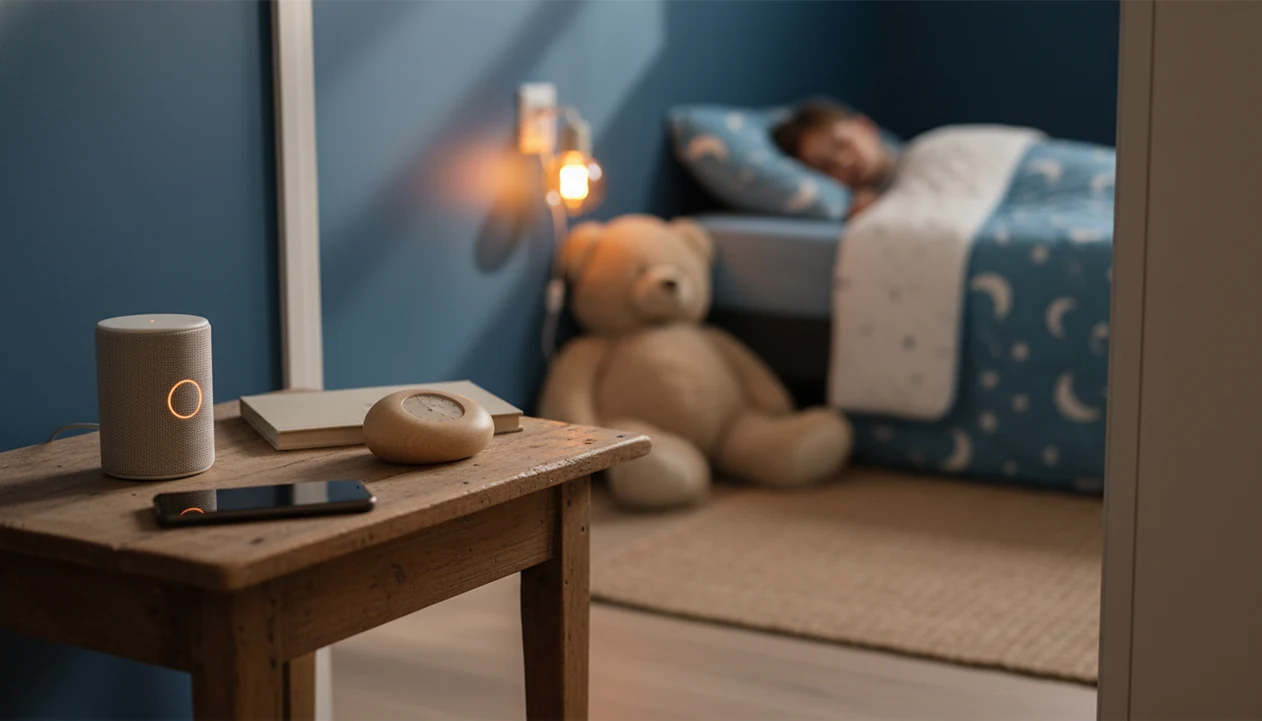
Definition: A bedtime story sleep timer is an app feature that stops kids' audio content (stories, lullabies, meditations) after a parent-set time window, using a gentle fade-out so the transition to silence feels smooth.
What a Kids Audio Sleep Timer Does at Bedtime
A kids audio sleep timer lets a parent choose how long bedtime stories, lullabies, or sleep meditations play before the sound fades out. Most families use a 10 to 60 minute window, with shorter settings for naps and longer settings for children who need more settling time.
The small detail that matters is the fade. A hard stop can make a drowsy child lift their head and ask what happened. A gradual fade lets the room move toward quiet without a new interruption.
At 7:15 p.m., after pajamas, toothbrush, and one missing stuffed rabbit, automatic stop matters. You don't have to open the door again.
In a study of more than 10,000 young children, regular bedtime routines were associated with earlier bedtimes, shorter sleep onset, and fewer night wakings (Mindell et al., Sleep, 2015: https://pubmed.ncbi.nlm.nih.gov/25390765/). A sleep timer is not the whole routine, but it can protect the last calm piece of it.
How a Bedtime Story Sleep Timer Works
A bedtime story sleep timer works by pairing a parent-set countdown with a gradual audio fade and reduced screen exposure. The behavioral idea is simple: the same calm sound window repeats often enough that it becomes a sleep-onset cue.
- Timer start: A parent chooses the duration, then Kids Bedtime TL counts down in the background.
- Fade-out: The final minutes lower volume gradually instead of cutting off the story.
- Screen control: Screen-off or dim mode keeps the device from lighting the room.
- Sleep association: Timed audio can become a conditioned cue, meaning the child learns, “this sound means wind-down.”
- Routine support: Research on bedtime routines links consistent calming activities 30 to 60 minutes before sleep with better child sleep and improved maternal mood.
Behavioral Sleep Cue Behind the Timer
Small pilot work on bedtime audio stories has explored helping children with sleep-onset association issues practice falling asleep more independently. The practical lesson is modest but useful: predictable audio can replace some repeated parent presence when it is used gently.
Why Audio-Only Beats Screen-Based Playback
Experimental research in preschool-age children has found that evening bright-light exposure can strongly suppress melatonin before bedtime (Akacem et al., Physiological Reports, 2018: https://pmc.ncbi.nlm.nih.gov/articles/PMC6175784/). Audio-only routines avoid that screen-light problem. Phone face-down on the dresser. Story still playing softly.
How to Use a Sleep Timer for Kids Stories
Use a sleep timer for kids stories as the final audio step in a predictable sequence, not as a last-minute rescue after high-energy play. The most useful setup is boring on purpose.
- Choose age-appropriate audio: Pick a gentle story, lullaby, meditation, or ambient sound that matches your child’s age and mood.
- Set the timer duration: Start with 20 to 30 minutes for toddlers, then adjust based on how long settling usually takes.
- Enable screen-off mode: Turn on screen-off or dim mode before placing the device near the bed.
- Lower the volume: Set audio low and steady, like a soft voice from the hallway.
- Let the fade-out finish: Avoid re-entering the room to stop playback manually unless your child needs you.
Parents using Kids Bedtime TL for short evenings often pair the timer with bedtime stories for kids rather than browsing from scratch. If sleep comes faster over time, shorten the timer by 5 minutes every few nights.
When to Use a Bedtime App Timer in Your Routine
A bedtime app timer fits best when a child already has a calm sequence and needs a gentle transition from parent presence to independent settling. It is especially useful for toddlers and preschoolers, roughly ages 2 to 5, who ask for “Just one more story” after lights out.
For naps, shorter timers often work better. Ten to 15 minutes may be enough when curtains are pulled against bright noon and the goal is a midday reset, not a long bedtime wind-down.
Travel is another good use case. A tablet propped on a suitcase can keep the same story routine available in a hotel room, especially with offline story downloads.
Do not start timed audio immediately after active tablet games, loud videos, or high-energy play. Calm bedtime content gives children a predictable sequence, not a way to erase overstimulation. The broader sleep context matters: CDC youth surveillance has repeatedly found that most U.S. high school students get less than the recommended amount of sleep (CDC: https://www.cdc.gov/healthyschools/features/students-sleep.htm), which is one reason early bedtime habits deserve attention.
Ready to start your quit?
A bedtime story sleep timer automatically fades out stories, lullabies, or sleep meditations after a set duration so your child drifts off without audio running all night. In Kids…
Sleep Timer Features Inside Kids Bedtime TL
Kids Bedtime TL includes a bedtime app timer designed for real family use, because parents need fast controls after the room is already dark. The timer works across stories, lullabies, sleep meditations, and ambient sounds.
- Adjustable timer: Set 5 to 60 minutes, or choose a custom duration for unusual nights.
- Two-minute fade: Audio fades over the final 2 minutes so silence does not arrive suddenly.
- Automatic screen-off mode: The screen turns off when the timer starts, reducing room light.
- Child-safe library: Content avoids ads, sudden volume jumps, and stimulating story themes.
- Nightly duration limit: A default maximum helps parents prevent hours of repeat playback.
Kids Bedtime TL fits families who want bedtime audio without handing over an active screen, because the sleep timer, screen-off mode, and content filters work together in one workflow. The same timer also supports lullabies and meditations listed in the best kids bedtime stories app guide.
Bedtime Story Sleep Timer vs Alternative Methods
A bedtime story sleep timer is different from leaving audio on, manually stopping playback, or relying on phone settings. The main difference is that the timer ends the audio without adding a parent visit or a bright screen moment.
| Method | What it does | Main tradeoff |
|---|---|---|
| Sleep timer with fade-out | Stops bedtime audio after a set window | Requires choosing a sensible duration |
| Manual stop | Parent returns to stop the story | Door noise or light can wake a nearly asleep child |
| All-night loop | Plays stories or sounds continuously | Ongoing stimulation may fragment sleep |
| No audio | Keeps the room silent | Works for some children, but not those who use audio as a calm-down cue |
| Do-not-disturb mode | Silences notifications | Does not stop story playback |
A sleep timer is not the same as screen time when the screen is off and the child is only hearing audio. Kids Bedtime TL covers that distinction with screen-off playback, while broader services such as calm.com, headspace.com, or moshi.com may organize content less tightly around toddler bedtime timing.
For children who settle with sound, a timed fade-out is often easier than all-night looping because it preserves the cue without keeping narration active for hours.
Related Kids Bedtime TL Features for Sleep Routines
Kids Bedtime TL connects the sleep timer to other routine tools, so parents can choose what to play without rebuilding the plan every night. The practical question is usually not “what feature exists,” but “what should I play at 8:02 p.m. when the room is finally quiet?”
The related features include toddler sleep meditations, a lullaby library with timer integration, nap routine presets, and age-based content filters. A short nap story can be queued softly for midday, while a longer read-aloud option can sit under the low hum of a white-noise track at night.
Parents comparing platforms can use the kids bedtime stories app for iPhone page or the kids bedtime stories app for Android page to check device fit before downloading.
Limitations
A sleep timer is useful, but it is not a treatment plan or a guarantee. It works best when the rest of bedtime is already reasonably consistent.
- Evidence for sleep timers is indirect; it comes mostly from bedtime routine, audio story, and light exposure research, not large trials on timer features alone. That means the strongest claim is routine support, not that a timer alone causes better sleep. Parents should treat the timer as one controlled part of the bedtime environment. - Some children may form a strong sleep-onset association with audio and struggle when it is unavailable. - A timer does not replace pediatric evaluation for persistent insomnia, anxiety, snoring, breathing concerns, or suspected medical sleep disorders. - Highly sensitive children may find even quiet narration, music, or ambient sound too stimulating. - If a phone or tablet screen stays bright, the light exposure risk remains. - Inconsistent bedtimes, rough play, scary videos, or late sugar can still overpower a well-set timer. - Competitors such as vooks.com or storyberries.com may suit families who prefer visual stories or web reading, but visual formats need extra care near bedtime.
Kids Bedtime TL is a routine support, not a shortcut around parent judgment.